Knowledge Graphs and Semantic Layers for Data Democratization
In a session at the Data Science Innovators Conference 2023, Navin Sharma of Stardog showed how a knowledge graph can infer relationships through domain rules, using a royal family dataset and demos in manufacturing, life sciences and finance. He also cited vendor ROI figures and answered questions on ontologies and Microsoft Purview.
By The AI Enterprise Magazine Team4 min read
Key takeaways
- Infer, don't reshape. Domain rules let a semantic layer derive relationships such as grandparent without new tables or pipelines.
- Business terms for business users. A semantic layer lets non-engineers ask questions in familiar terms like products and customers.
- Leave data in place. Sharma described virtualizing data across silos to limit sprawl and governance issues.
- Domains can stay separate. Business units can keep their own rules while remaining semantically aligned.
- Weigh vendor ROI claims. Sharma cited about $9.8 million over three years for large clients, a figure presented in the session.
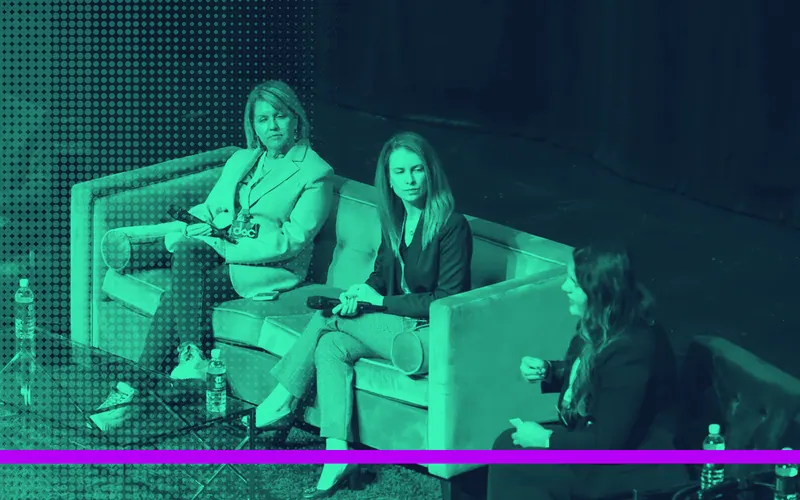
In a session at the Data Science Innovators Conference 2023, Navin Sharma, vice president of product at Stardog, explained how a knowledge graph can power a semantic layer that lets business users query enterprise data without waiting for engineers. In "Knowledge Graphs, Semantic Layers, and Data Democratization, Oh My!", a deeper follow-up to his keynote at the same event, Sharma used a British royal family dataset and demos from manufacturing, life sciences and finance to make the case.
What is a semantic layer?
Sharma defined a semantic layer as a business representation of an organization's most critical data that helps end users access it on their own using common business terms such as products, customers and revenue. The goal, he said, is a unified view across the organization for people who are not data engineers or data scientists.
He described the mechanism as taking the metadata, the description of the data at the source, and enriching it semantically to produce new insight. Sharma noted that Gartner research recommends a semantic approach to enterprise data to avoid "endless battles with data silos."
How does a knowledge graph infer relationships without reshaping data?
Sharma's example used two relational tables: one listing members of the royal family, and one linking parents to children. Business users want more than parent and child. They want grandparents, siblings and cousins.
The usual options, he said, are to redesign the data model with more tables and joins, or to build complex pipelines. He described a third option: annotate the data model with domain rules, such as a grandparent being a parent of a parent. The relationships are then inferred rather than physically stored. Using the same two tables, he could ask who Harry's grandmother was and get an answer, without changing the underlying source.
What are the industry use cases?
Sharma outlined three areas. In healthcare and life sciences, researchers could connect studies, compounds, suppliers and clinical trials to speed drug discovery. In manufacturing, a supply chain digital twin could help a factory floor analyst trace a bill of materials and its suppliers. In financial services, the examples were customer 360, know your customer, financial crimes and operational risk.
He demonstrated three scenarios in Stardog Explorer. In the first, a quality note about a damaged trunk door seal for one vehicle led to the material, its supplier and seven other non-conformance reports. In the second, he searched for studies on oxytocin and autism and saw which sites and sponsors were involved. In the third, he explored investor and employee relationships among companies and people in synthetic data. He stressed that the finance data was dummy data and implied no wrongdoing.
How does this fit with data fabric and data mesh?
Sharma said a Gartner analyst had remarked that knowledge graphs are the secret ingredient to a data fabric. In practice, he described a semantic data layer powered by a connected knowledge graph of business domains, sitting on top of data lakes, warehouses and operational stores, which resembles a data mesh with domain-centric data products.
Leaving data where it is, he said, limits sprawl and governance issues. Different business units can keep their own domain rules and access policies, as long as they stay semantically aligned. Sharma said not everyone must agree on one definition of a customer.
He laid out a five-step approach. Harvest metadata, whether from a catalog such as Collibra, Microsoft Purview or Databricks Unity, or directly from sources. Ingest or virtualize the data. Semantically enrich it with business context. Apply inference rules, from simple logic to machine learning. Then present results through SQL endpoints, notebooks or APIs.
What ROI did Sharma cite?
Sharma cited an independent ROI study of companies that deployed a knowledge graph platform. According to his summary, it showed data scientist and engineer productivity gains of 75 to 95 percent, benefits of about $3.8 million, and a roughly $9.8 million return over three years for large enterprise clients. These are vendor-cited figures and were not independently verified in the session.
He also cited scale testing up to a trillion triples with about 85 percent of data virtualized. On skills, he said teams do not need a new specialty, because tools exist for data modelers and engineers to work in familiar ways.
What did he say in the Q&A?
Asked about pre-existing ontologies, Sharma said Stardog can use them, noting industry groups in life sciences and manufacturing have done much of the work. He said Stardog was exploring large language models to speed creation of semantic models. He also said knowledge graphs can supply a business vocabulary to feed large language models.
On Microsoft Purview, he said Stardog can connect to it and harvest metadata, then combine that with access to the underlying records.
Where to hear more
AI Connect continues to cover semantic layers, knowledge graphs and enterprise data. The 2027 schedule includes 24 free live webinars in four series: the AI x Enterprise Panel Series, AI Demo Days, Agentic AI Showcases and the Plug & Play Series. Details are at /webinars/, and registration for 2027 events is coming soon.
Frequently asked questions
What is a semantic layer?
Sharma defined it as a business representation of an organization's critical data that lets users access it using common business terms like products, customers and revenue.
How does a knowledge graph help with data silos?
It connects data across sources by concept, infers relationships from domain rules, and can virtualize data in place instead of copying it.
Can a knowledge graph connect to Microsoft Purview?
Sharma said Stardog can connect to Purview, harvest its metadata and combine it with access to the underlying records.
Can existing ontologies be reused?
Yes, Sharma said, noting industry groups in life sciences and manufacturing have already built many.
This article is based on remarks by Navin Sharma, VP, Product, Stardog at Data Science Innovators Conference 2023 on April 12, 2023. More coverage: More AI Connect Events.
Filed under: Context, Semantics & RAG, Data & AI Infrastructure, AI Use Cases & Applications